AIS 140 GPS Tracker and VLTD Compliance in Delhi
In Delhi, AIS-140 is administered by the Transport Department of the Government of NCT of Delhi, and the public-vehicle tracking backend has been moving from the DIMTS-managed Command and Control Centre to a new NIC-managed vehicle location tracking and emergency alert system. This page covers what that shift means for autos, taxis, app-based cabs, cluster buses and school transport in Delhi — and where a Delhi-based manufacturer fits in.
Delhi's VLTD chain: Transport Department, DIMTS and the move to an NIC backend
In Delhi the notifying and enforcing authority is the Transport Department, Government of NCT of Delhi. Delhi does not have a district-wise RTO network the way larger states do — it works through zonal transport offices and Motor Licensing Officers at locations such as Mall Road, Sarai Kale Khan, Janakpuri, Loni Road and Wazirpur. That is where fitness, permit and VLTD paperwork is actually settled, so "which RTO" in Delhi usually means "which zonal office".
What really makes Delhi different is the backend. For years the automatic vehicle location system for para-transit and public service vehicles ran through a Command & Control Centre set up by DIMTS (Delhi Integrated Multi-Modal Transit System Ltd, a joint venture of the Delhi government), following directions of the Hon'ble Supreme Court. Device models had to be registered specifically for Delhi, and Delhi kept two registration tracks: one for VLT devices with an emergency system for specified public service vehicles, and a separate one for electronic fare meters for para-transit. DIMTS states the platform tracks over 1,50,000 vehicles in Delhi alone.
In September 2024 the Transport Department signed an MoU with the National Informatics Centre (NIC) and NICSI for a new AIS-140 backend and monitoring centre covering vehicle location tracking and the emergency alert system, reported as funded by MoRTH under the Nirbhaya Framework. Public vehicle owners are being moved off the DIMTS-managed system onto the NIC-managed one.
In plain terms: your device's server address and APN configuration must point at whichever backend the department is accepting today, and the department has instructed registered VLTD vendors to whitelist the VLTS application domain inside their devices. Get your supplier to confirm both in writing before fitment — a device that was reporting fine in 2023 can sit silent on the new dashboard.
Delhi also announced in 2024 that the annual VLTD subscription fee public vehicle owners had been paying would be waived, covering roughly 1.5 lakh vehicles. Treat that as an announcement and confirm the current position at your zonal office. For the standard itself rather than Delhi's plumbing, see our AIS-140 rules explained guide.
Which Delhi vehicles the VLTD mandate actually bites on
Delhi's public transport mix is unusual, and the categories the department pushed first reflect that:
- Auto rickshaws (TSR) — the city's para-transit backbone. GPS was made mandatory for three-wheelers, and Delhi's route is distinctive: location data has flowed from the GPS-based electronic fare meter in the auto, not only from a standalone tracker. GPSBULL builds a DIMTS-compliant taxi and auto fare meter alongside its AIS-140 trackers.
- Taxis and app-based cabs — under the Delhi Motor Vehicle Aggregator and Delivery Service Provider Scheme, 2023, aggregators must onboard M1 passenger four-wheelers fitted with an AIS-140 certified tracking system with panic button, with panic alerts integrated in real time to law-enforcement — in Delhi that means the 112 emergency response chain. The aggregator's own control centre is expected to hold trip origin-destination, route and panic-alert data.
- Gramin Sewa and Phat Phat Sewa — the white eight-seater last-mile wagons and the older Phat Phat vehicles are Delhi-only categories, and permit compliance for them has included working GPS.
- DTC and cluster buses — Delhi's cluster scheme buses and the DTC fleet have carried GPS/vehicle tracking devices and electronic ticketing machines since around 2010, feeding the arrival data commuters see in bus apps. Operators bidding for cluster or premium bus work should expect tracking, panic button and data-sharing conditions in the contract, not only in the permit.
- Interstate, contract carriage, tourist and staff buses — running out of ISBT Kashmere Gate, Anand Vihar and Sarai Kale Khan into UP, Haryana, Punjab and Rajasthan, where a second state's backend may also want a feed.
- Goods vehicles — not the core AIS-140 category, but Delhi's freight ecosystem around Sanjay Gandhi Transport Nagar, Azadpur, Okhla and Mayapuri runs on tracking for insurance, theft and delivery reasons of its own.
Autos and e-rickshaws have been treated differently from other public service vehicles at the central level, and Delhi is simultaneously pushing e-autos and electric commercial vehicles. Read your own permit conditions rather than assuming a category is exempt. Enforcement in Delhi is not really a border-checkpost affair — it shows up when fitness and permit renewal come around, and in Transport Department enforcement and Delhi Traffic Police checks on the road. See VLT devices and panic button devices for what is fitted.
School buses and school cabs in Delhi
Delhi carries one of the country's biggest school transport loads, and the Transport Department maintains a dedicated School Cab section publishing the School Cab Policy, permit conditions for safety of school transport, and the procedure for registering private motor vehicles under the school cab scheme. School buses and school cabs need a contract carriage permit endorsed for school use, and Delhi school transport is generally expected to carry a speed limiting device, tracking, an emergency/panic button and an attendant. The Delhi High Court has also pressed the city government on panic buttons and tracking devices in buses.
For a Delhi school or transport contractor the real test is not "is a device fitted" but:
- Does a panic press reach someone who acts — a named person, not just a log entry?
- Can the transport in-charge see every bus live during the morning and afternoon runs, including the Gurugram and Noida legs many Delhi schools operate?
- Is the device reporting to the department's backend, and not only to a private app?
Our school bus GPS tracking page and the school bus tracking checklist cover what to ask a supplier. Speed limiting is a separate fitment — see speed governors.
Fitting and running VLTD in Delhi: CNG fleets, NCR running and same-city support
Almost everything here is CNG or electric
Delhi's commercial fleet is overwhelmingly CNG or electric — autos, taxis, cluster buses, RTVs, e-rickshaws. Wiring a tracker around a CNG kit or an EV harness is a different job from a diesel truck, and a careless tap produces ignition-status and voltage errors that later read as "device not reporting" on the department dashboard. Use a fitment centre that has done Delhi CNG work, and insist on a fitment certificate you can take to the zonal office.
Delhi vehicles do not stay in Delhi
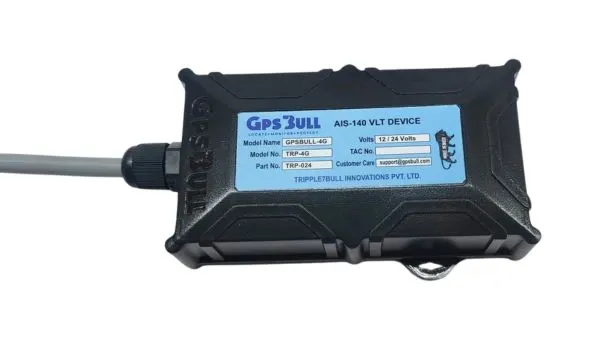
A Delhi-registered cab, school bus or staff bus crosses into Noida, Ghaziabad, Gurugram or Faridabad most days. A single-operator SIM that is perfect in Karol Bagh can drop in a Ghaziabad basement or on a Gurugram service road. The GPSBULL AIS-140-4G device (TRP-4G, part TRP-024) runs 4G LTE on a dual-network embedded SIM with GPS + GLONASS + IRNSS (NavIC), IP68 housing, 12/24 V input, SOS panic button support, tamper and over-speed alerts, remote immobilization and over-the-air configuration, and carries ARAI type approval TAC AS9026. With 2G networks winding down, an older 2G VLTD is the first thing to audit — see the 2G shutdown and AIS-140 upgrade guide.
Delhi's built environment matters too. Multi-level parking at Nehru Place and Karol Bagh, mall basements, and the flyover corridors along the Ring Road all cause short GPS drift. Judge a device on how fast it re-fixes after a basement, not on one parked reading.
A Delhi manufacturer, in Delhi
GPSBULL is a brand of Tripple7Bull Innovations Pvt. Ltd., manufacturing at 33 FF, Meera Enclave, Chaukhandi, Delhi 110018 — West Delhi, minutes from the Janakpuri zonal office. Delhi operators, fitment centres and dealers get same-city support rather than a courier round trip, backed by ISO 9001:2015 and CMMI Level 3 certified processes and 500,000+ devices deployed across 7+ countries. Toll-free 1800 270 8677, info@gpsbull.com; office Mon-Sat 10-7 IST, device support 24/7. Pricing is quote-only.
Buying a tracker for general fleet or personal use rather than permit compliance? Start at GPS trackers in Delhi. For the registration paperwork, see Vahan VLTD registration step by step, and for platform features fleet management.
Cities and districts we supply in Delhi
New Delhi · Janakpuri · Dwarka · Rohini · Karol Bagh · Okhla · Sanjay Gandhi Transport Nagar · Mayapuri · Anand Vihar · Narela — and the rest of Delhi. Devices ship from our New Delhi plant; dealers, fitment centres and fleet operators are supported directly, with 24/7 device support after installation.
Frequently asked questions — Delhi
Which backend does a VLTD in Delhi have to report to?
Historically Delhi's public service vehicle tracking ran through a Command and Control Centre set up by DIMTS. In September 2024 the Transport Department signed an MoU with NIC and NICSI for a new AIS-140 backend and monitoring centre for vehicle location tracking and the emergency alert system, and owners are being migrated to it. Because this transition is live, confirm the current server configuration with your zonal transport office or your registered VLTD supplier before fitment — do not assume an old configuration still works.
Do I need a VLTD to renew my permit or fitness in Delhi?
For the public service vehicle categories notified under CMVR Rule 125H, a working VLTD with an emergency button is part of the vehicle's compliance, and states link it to permit and fitness processes through Vahan. Delhi applies this as notified. Since the exact category coverage and timing can change, verify against your own permit conditions at your Delhi zonal transport office rather than relying on a general list.
Are auto rickshaws in Delhi covered, and what about the fare meter?
Delhi is unusual here. GPS was made mandatory for three-wheelers, taxis and Gramin Sewa vehicles, and Delhi ran location reporting through the GPS-based electronic fare meter fitted in the auto as well as through tracking devices — the department maintained a separate registration track for electronic fare meters for para-transit. GPSBULL manufactures a DIMTS-compliant taxi and auto fare meter in addition to AIS-140 trackers. Autos and e-rickshaws have been treated differently from other PSVs at the central level, so check your permit conditions.
What do app-based cab operators in Delhi have to fit?
Under the Delhi Motor Vehicle Aggregator and Delivery Service Provider Scheme, 2023, aggregators are required to onboard M1 passenger four-wheelers with an AIS-140 certified vehicle tracking and monitoring system carrying a panic button appropriate to a public service vehicle, with panic alerts integrated in real time with law enforcement — the 112 chain in Delhi. The aggregator's control centre is expected to hold origin-destination, route and panic-alert data for trips.
Is there still an annual VLTD fee in Delhi?
Delhi announced in 2024 that the annual VLTD subscription fee charged to public vehicle owners would be waived, a step reported as covering around 1.5 lakh vehicles, alongside the NIC backend arrangement. Announcements can be revised, so confirm the current fee position with the Transport Department or your zonal office before budgeting.
Can GPSBULL support fitment and service in Delhi itself?
Yes. GPSBULL manufactures in New Delhi at 33 FF, Meera Enclave, Chaukhandi, Delhi 110018, and ships pan-India from there, supporting dealers, fitment centres and fleet operators. Delhi customers get same-city support instead of a courier round trip. Toll-free 1800 270 8677 or info@gpsbull.com; office hours are Mon-Sat 10-7 IST with 24/7 device support. Pricing is provided on quote.
Fitting AIS-140 devices in Delhi? Talk to the manufacturer.
Speak directly with the manufacturer — device specifications, state-wise compliance guidance, dealer pricing and bulk quotes. Office: Monday–Saturday, 10 AM–7 PM IST. Device support: 24/7.
Official sources
- Transport Department, Government of NCT of Delhi
- Delhi Transport Department — School Cab policy and permit conditions
- Vahan portal (MoRTH)
Rules, deadlines and empanelment lists are set by the state transport department and change over time — confirm the current position for your vehicle category with your RTO before purchase.