AIS 140 GPS Tracker in Goa: VLTD Compliance for Tourist Taxis, Buses and Trucks
Goa runs its own Vehicle Location Tracking & Emergency Alert System portal under the Directorate of Transport, Panaji, and the state has moved away from a closed empanelled supplier list — a public service vehicle operator may buy an AIS-140 compliant VLTD and emergency button from any vendor, provided the maker is enlisted with the department and the fitment is updated on Vahan. This page covers how that works in practice for tourist taxi, bus, school and goods fleets from Pernem down to Canacona.
Goa runs its own VLT & EAS portal — start there, not with a national helpdesk
Goa does not route VLTD compliance through a generic national desk. The Directorate of Transport, Panaji, operates a state system it calls the Vehicle Location Tracking & Emergency Alert System (VLT & EAS), hosted at gavlts.goa.gov.in. The department presents it as an AIS-140 certified and IS 16833 compliant solution whose purpose is to identify a public service vehicle in real time and push an emergency button press through to the Emergency Response Support System, with monitoring of device health on the department side.
Two lines on that state portal settle most Goa fitment questions before you spend anything:
- Who is covered. The portal applies the requirement to public service vehicles of four wheels or more, and states that auto rickshaws and e-rickshaws are exempted. That is a genuine difference from states that pulled three-wheelers in, and it matters in a state with a large auto and pilot trade.
- Which vehicles. The portal ties the AIS-140 device requirement to vehicles registered on or after 1 January 2019, on top of the permit and fitness conditions your Assistant Director of Transport office applies at renewal.
Goa also stepped back from a closed supplier list. The Directorate withdrew vendor empanelment for VLTDs and digital fare meters, and its public notice allows the operator of a public service vehicle to buy the tracking device and emergency button from any vendor, so long as both comply with AIS-140. The catch is the next line of the same notice: the VLT device manufacturer, its OEM dealer or an authorised dealer must do the installation, and the device details must be updated against the vehicle number on the Vahan portal.
Fitment dates in Goa have been announced through departmental public notices rather than one permanent rule, so confirm the date that applies to your permit class with the Directorate or your ADT office before booking a slot. If you want the standard itself explained rather than the Goa layer, read our AIS-140 rules explained guide.
In Goa, enlistment is the device maker's job — verify it before you buy
The paperwork that actually gates your fitment in Goa sits with the device manufacturer, not with you. Before a VLTD brand can be activated on Goa vehicles, the maker has to be enlisted with the Directorate through the state portal. The published process runs like this:
- Apply online as a vendor and upload the Type Approval Certificate (TAC) or Certificate of Conformity, along with the Company Identification Number certificate.
- Clear a one-time compatibility test — tag a test vehicle on the MoRTH VLTD maker portal on Vahan, then configure the device to the URL and port the Goa department specifies.
- Track that test on the portal's status page using the device IMEI and a registered mobile number.
- On approval the department issues one user-id per vendor, with further logins created for RFCs and authorised dealers who will do the field activations.
For a taxi owner in Panaji or a bus operator in Margao, the practical version is one question to your supplier: is your device enlisted with the Goa Directorate of Transport, and is it streaming to the Goa backend? An AIS-140 certificate on its own does not make a unit usable here — the device also has to reach the state server on the address the department issued to the maker, and someone with a valid dealer login has to activate it.
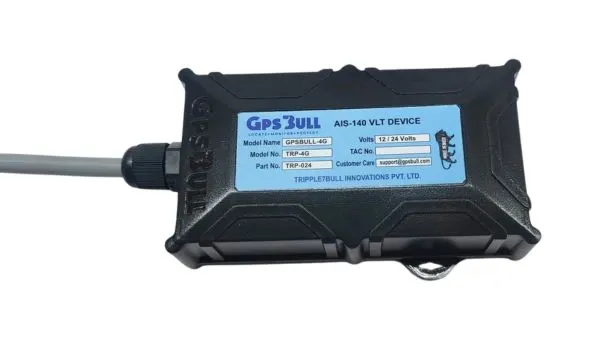
Because Goa's addressing sits with the department, over-the-air configuration is worth having: it lets a backend address or port change be pushed to units already bolted into vehicles instead of calling every taxi back to a workshop. The GPSBULL AIS-140-4G device (model TRP-4G) is AIS-140 certified with ARAI type approval TAC AS9026 and supports over-the-air configuration, GPS with GLONASS and IRNSS (NavIC), and a 4G dual-network eSIM.
The two things Goa's system is built around are the live location stream and the emergency button, and both have to be working, not merely fitted. For the Vahan side of the job, see Vahan VLTD registration step by step.
Goa's fleet mix: tourist taxis, rent-a-cab, mining tippers and school buses
Goa is a small state with an unusually concentrated and unusually seasonal commercial fleet. A handful of segments drive nearly all the VLTD work here, and each one has its own Goa-specific wrinkle.
Tourist taxis and the app-cab argument
The tourist taxi trade is the loudest transport constituency in Goa, and VLTD arrived in the middle of the app-cab fight. Alongside the tracking device, a motorcab in Goa is expected to carry a digital fare meter with printer and GPS, with the Legal Metrology seal intact — and, as with VLTDs, operators may now source meters from any vendor meeting the condition in the Goa Motor Vehicles Rules, 1991 rather than a shortlist. Amendments have gone further and allowed an aggregator's app to serve as the fare meter where it can issue SMS or email invoices, removing the physical printer requirement in that case. Transport aggregator guidelines notified in 2025 add their own conditions, including Goa-registered or Goa-permitted vehicles and badge-holding drivers. The result is that one Goa taxi can be carrying a VLTD, a sealed meter and an aggregator app at the same time — confirm the current combination for your permit with the Directorate.
Two airports and a five-month peak
Goa works two airports — Dabolim near Vasco da Gama and Manohar International at Mopa in Pernem — with tourist taxi registration handled at the tourism corporation's airport counter. Demand collapses into the October-to-February window, so devices here run long continuous duty cycles for part of the year and sit idle for the rest. Ignition, idle and battery-disconnect alerts are worth configuring for that pattern rather than leaving at defaults.
Rent-a-cab, pilots and self-drive
Goa's self-drive rent-a-cab and rent-a-motorcycle schemes, plus its legal motorcycle pilots, are close to unique in India. Whether a VLTD condition attaches depends on the permit class the vehicle holds, not on the fact that it is rented — check the class with your ADT office rather than assuming. Where a four-wheeler is registered and permitted as a public service vehicle, the state portal's coverage line applies.
Mining tippers, quarries and the port
Goa's mining legacy still shapes its goods fleet. The Directorate of Mines & Geology issues transit permits for minor minerals online, and vehicles carrying minerals are required to run GPS and RFID, with check post officers verifying permits against the vehicle. A Goa tipper therefore often carries two separate identities — the mines department's permit and RFID trail, and the transport department's AIS-140 stream — and they are not the same system. Fleets running mining and quarry vehicles or construction fleets usually want both on one dashboard. Trailer and container movement out of Mormugao port towards Karnataka and Maharashtra falls under ordinary logistics tracking needs.
School and staff buses
Goa schools cluster tightly around Panaji, Porvorim, Margao, Mapusa and Vasco, with long taluka runs into Sattari and Canacona. A school bus GPS tracker with a working panic button, paired with a speed governor where the permit requires one, is the usual combination parents and managements ask for.
Fitment, network coverage and getting it done across Goa
Goa does not use the word RTO the way most states do. The registering and transport work is handled by Assistant Director of Transport offices under the Directorate of Transport in Panaji, so when a supplier tells you to "go to the RTO", what you actually need is the ADT office your permit is tied to.
Fitment demand concentrates in a narrow band: Panaji and Porvorim, Mapusa, Margao, Vasco da Gama and Mormugao, and Ponda. Taluka volumes at Bicholim, Curchorem and Quepem, Canacona, Pernem, Valpoi and Sanguem are smaller, which in practice means fewer walk-in fitment options and more reason to work with a dealer who will travel.
Coverage is not uniform — plan for it
The coastal strip and the Panaji-Margao corridor are well served, but Goa has three conditions that punish a weak device:
- The Ghats belt. Sattari, Sanguem, Dharbandora and the Canacona hinterland sit against the Western Ghats, where a single-network SIM can drop for long stretches on ore, timber and quarry routes.
- River crossings. Ferry and bridge crossings on the Mandovi, Zuari and Chapora put vehicles in short signal shadows and produce ugly gaps in trip replays if the device does not buffer.
- Monsoon. June to September is heavy, sustained rain. Sealed housing and clean wiring at the fitment stage save far more money than they cost.
Those three together are the argument for a 4G device with a dual-network embedded SIM, IP68 housing and store-and-forward buffering so positions recorded in a dead spot are uploaded once the vehicle reconnects, plus IRNSS (NavIC) alongside GPS and GLONASS for a faster fix under tree cover. That is the configuration of the GPSBULL AIS-140 GPS tracker.
Tune alerts for short Goa trips
A Goa taxi may do a dozen short hops between beach belts in a day, and a default alert profile built for highway trucking will bury you in notifications. Set over-speed thresholds, idle timers and stop detection for that pattern in driver behaviour monitoring, and use fleet management reports rather than live alerts for anything that is not safety-critical.
Working with GPSBULL
GPSBULL is a brand of Tripple7Bull Innovations Pvt. Ltd., manufacturing in New Delhi with ISO 9001:2015 and CMMI Level 3 certified processes, and more than 500,000 devices deployed across 7+ countries. We ship pan-India from New Delhi and support dealers, fitment centres and fleet operators in Goa. Office hours are Monday to Saturday, 10 to 7 IST, with 24/7 device support. Pricing is quote-only — call 1800 270 8677 or write to info@gpsbull.com with your permit class, vehicle count and the ADT office you report to, and we will tell you exactly what your Goa fitment needs.
Cities and districts we supply in Goa
Panaji · Margao · Vasco da Gama · Mapusa · Ponda · Bicholim · Curchorem · Quepem · Canacona · Pernem — and the rest of Goa. Devices ship from our New Delhi plant; dealers, fitment centres and fleet operators are supported directly, with 24/7 device support after installation.
Frequently asked questions — Goa
Is an AIS-140 VLTD mandatory in Goa, and for which vehicles?
Goa's Directorate of Transport requires VLTD and emergency button fitment on public service vehicles, and its state VLT & EAS portal applies this to public service vehicles of four wheels or more, tied to vehicles registered on or after 1 January 2019. The same portal states that auto rickshaws and e-rickshaws are exempted. Fitment dates have been announced through departmental public notices rather than one fixed rule, so confirm the date and category that apply to your permit with the Directorate or your Assistant Director of Transport office.
Do I have to buy from a government-empanelled vendor in Goa?
No. Goa withdrew the vendor empanelment system for VLTDs and digital fare meters. The department's public notice allows the operator of a public service vehicle to buy the tracking device and emergency button from any vendor, provided both comply with AIS-140. What still matters is that the device manufacturer is enlisted with the Goa Directorate, that installation is done by the manufacturer, its OEM dealer or an authorised dealer, and that the device details are updated against the vehicle number on Vahan.
What does 'enlistment' mean on the Goa VLT portal, and do I have to do it?
Enlistment is a manufacturer-side process, not an owner-side one. The device maker applies online, uploads its Type Approval Certificate or Certificate of Conformity and Company Identification Number certificate, clears a one-time compatibility test by tagging a test vehicle on the MoRTH VLTD maker portal and pointing the device at the URL and port Goa specifies, then receives a user-id from the department. As a vehicle owner you do not file this — you simply verify that the brand you are buying is already enlisted and streaming to the Goa backend.
Where does the panic button alert go in Goa?
Goa's system is described by the Directorate as a Vehicle Location Tracking and Emergency Alert System designed to identify the vehicle in real time and route an emergency press through to the Emergency Response Support System, with the department also monitoring device health. That is why a dead or unactivated device is treated as a compliance problem and not just a hardware fault — the alert path only works if the unit is live on the state server.
Do Goa tourist taxis need a fare meter as well as a GPS tracker?
They are two separate requirements. Alongside the AIS-140 VLTD, a motorcab in Goa is expected to carry a digital fare meter with GPS and an intact Legal Metrology seal under the Goa Motor Vehicles Rules, 1991, and meters may now also be bought from any vendor meeting that condition. Amendments have allowed an aggregator's app to act as the fare meter where it issues SMS or email invoices instead of a printed receipt. Because this area has changed more than once, confirm the current position for your permit class with the Directorate of Transport before you buy.
Which office in Goa handles VLTD and permits — is there an RTO?
Goa's registering and transport functions sit with Assistant Director of Transport offices under the Directorate of Transport in Panaji, rather than offices branded RTO. Fitment and paperwork volumes concentrate around Panaji and Porvorim, Mapusa, Margao, Vasco da Gama and Ponda, with smaller offices serving Bicholim, Curchorem and Quepem, Canacona, Pernem, Valpoi and Sanguem. Always confirm your permit conditions with the office your vehicle is registered under.
Fitting AIS-140 devices in Goa? Talk to the manufacturer.
Speak directly with the manufacturer — device specifications, state-wise compliance guidance, dealer pricing and bulk quotes. Office: Monday–Saturday, 10 AM–7 PM IST. Device support: 24/7.
Official sources
- Goa VLT & EAS portal — Directorate of Transport
- Goa VLTD enlistment — how to apply
- Vahan portal (MoRTH)
Rules, deadlines and empanelment lists are set by the state transport department and change over time — confirm the current position for your vehicle category with your RTO before purchase.