AIS 140 GPS Tracker in Tamil Nadu — VLTD Compliance for TN Fleets
Tamil Nadu runs AIS-140 on its own track: the Commissionerate of Transport and Road Safety at Guindy, Chennai empanels VLTD manufacturers through an Expression of Interest, publishes the approved manufacturer and price lists on its own site, and routes device data into a state Command and Control Centre backed by C-DAC. This page covers what that means for buses, taxis, maxi cabs, school buses and goods carriers registered in TN.
How Tamil Nadu actually runs VLTD: the EOI, the published list, the CCC
The authority is the Commissionerate of Transport and Road Safety, Anna Salai, Guindy, Chennai 600032. In September 2025 it issued an Expression of Interest (EOI Ref. No. 8067/S3/VLTD/2020, released 04.09.2025) inviting Vehicle Location Tracking Device manufacturers to be empanelled for fitment to public transport vehicles in Tamil Nadu, with EOI opening set for 23.10.2025. The process runs under the Tamil Nadu Transparency in Tenders Act, 1998 and the Tamil Nadu Transparency in Tender Rules, 2000, read alongside AIS-140, and applications were submitted through the state e-procurement portal.
Two features of that document shape how buying and fitting works in TN:
- A published list, not an open market. The EOI says selected manufacturers' models will be published on the Transport Department's website — and TNSTA does carry VLTD manufacturer details, OEM contact details and an authorised VLTD manufacturer price list in its notices section. Tamil Nadu is one of the few states that puts device pricing on the department site at all. Check the current list before you pay anyone a rupee.
- A state backend at a Command & Control Centre. The CCC sits at the Transport Department headquarters. C-DAC is named for the backend role, and registered devices must integrate with it: Position-Velocity-Time data to a Primary IP, panic-button alerts to a Secondary (Emergency) IP, at a user-configurable interval down to five seconds. Monitoring logins go to RTOs, the State Emergency Response Team, the Police Department and MoRTH.
Tamil Nadu also writes language into the specification. Manufacturer mobile apps must offer an English and Tamil interface, zonal call centres must provide Tamil-language support, and empanelled makers must file monthly MIS reports to the Transport Commissioner through the portal. If you want the underlying standard rather than the state layer, read our AIS-140 rules explained guide.
The categories TN names — and where non-compliance actually stops you
Tamil Nadu's EOI scopes public service and transport category vehicles under CMVR 1989 into four groups:
- Buses — school buses, stage carriages, All India Tourist Permit vehicles and private service vehicles
- All types of taxis, on All India or State permits
- Maxi cabs
- All goods carriers, with water tankers and petroleum tankers called out by name
Vehicles Not Covered by Permit (NCP) are excluded, and the state reserves the right to add or remove categories later.
Enforcement in TN is not primarily a roadside affair. The EOI states that fitment and functional status is enforced at registration, permit issue or renewal, and the fitness check, through VAHAN and the State Monitoring Centre. That is the practical pinch point: a dead SIM or an unregistered device usually surfaces when you go for FC or permit renewal, not when a checkpost stops you.
Three operational details from the same document that catch operators out:
- The fitment centre must upload the VLTD make and model, Unique Identification Number, IMEI and ICCID to VAHAN, and the make/model is validated against type-approved entries uploaded by test agencies. A device fitted but not tagged is, on paper, not fitted. Our Vahan VLTD registration walkthrough covers this step.
- The connectivity plan is tied to vehicle age: a minimum two-year active cellular plan for a public service vehicle less than 8 years old, and one year for a vehicle older than 8 years.
- The manufacturer must give a minimum two-year warranty covering AMC, and must keep supporting devices already sold even if its own registration lapses.
These are the terms as set out in the state EOI. Rules and lists change, so confirm the position for your vehicle class with your RTO or the Transport Commissionerate before you commit.
What Tamil Nadu's fleet mix means on the ground
The state has 91 Regional Transport Offices across 38 districts, organised into 12 transport zones: Chennai North, Chennai South, Villupuram, Vellore, Salem, Thanjavur, Tiruchirapalli, Erode, Coimbatore, Madurai, Virudhunagar and Tirunelveli. An empanelled manufacturer must hold a 24x7 service and support centre in every one of those 12 zones within 30 days of the list being published, and a retro-fitment centre in each of the 91 RTO jurisdictions. That is a far heavier footprint requirement than most states impose, and it is worth asking any supplier which zone office actually covers you.
Chennai: taxis, maxi cabs and app-based fleets
Taxis on All India or State permits and maxi cabs are both named in scope, which puts Chennai's large call-taxi and app-cab population squarely inside the mandate. For these fleets the panic button wiring and the alert path to the Emergency Response Support System matter as much as the tracker itself.
Omni buses and tourist coaches
All India Tourist Permit vehicles and private service vehicles are listed explicitly. TN's omni bus and tourist coach operators running Chennai–Bengaluru, Coimbatore, Madurai, Tirupati and the temple and hill circuits are therefore covered, and permit renewal is where it gets checked.
School buses carry a second TN-specific rule
Beyond VLTD, the Tamil Nadu Motor Vehicles (Regulation and Control of School Buses) Special Rules, 2012 require a speed limiting device set so the bus does not exceed 40 kmph within Corporation limits and 50 kmph elsewhere — a split limit unique to the state. Most TN school fleets therefore need both a tracker with an emergency button and a speed governor. See our school bus GPS tracking page and the school transport checklist.
Ports, tankers and the industrial belts
Goods carriers including water tankers and petroleum tankers are in scope, which reaches the container and tanker movement around Chennai and Kamarajar (Ennore) ports and the V.O. Chidambaranar port at Thoothukudi, plus the Coimbatore–Tiruppur–Erode textile belt, the Hosur and Sriperumbudur–Oragadam manufacturing corridors, and the delta's long rural runs. Coverage on Western Ghats stretches, the Nilgiris, Yercaud and Kodaikanal is patchy, so multi-constellation positioning and a SIM that can hop networks are practical requirements, not marketing. See logistics tracking and fleet management.
Buying and fitting an AIS-140 device in Tamil Nadu
Order of operations
- Confirm your vehicle class is covered, and check the Transport Department's current published VLTD manufacturer and price lists on the TNSTA site before paying.
- Get the fitment done at a registered retro-fitment centre in your own RTO region, not wherever is nearest.
- Verify the make, model, UIN, IMEI and ICCID are uploaded and tagged on VAHAN and the state backend, and keep the acknowledgement.
- Keep the cellular plan valid for the required term for your vehicle's age, and re-register the device if you change the unit or the operator.
- Test the emergency button and confirm the device is live before you book your fitness or permit appointment.
The GPSBULL device
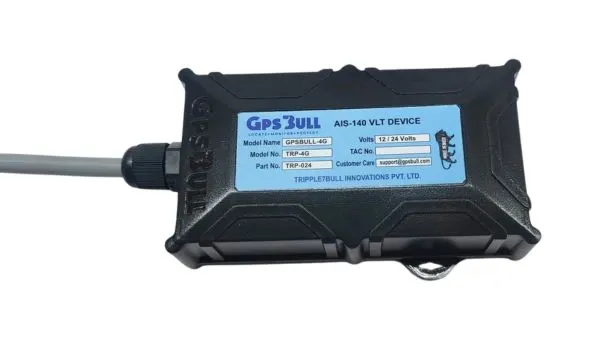
GPSBULL is a brand of Tripple7Bull Innovations Pvt. Ltd., manufacturing in New Delhi with ISO 9001:2015 and CMMI Level 3 certified processes, and 500,000+ devices deployed across 7+ countries. The GPSBULL AIS-140-4G, model TRP-4G (part TRP-024), is AIS-140 certified with ARAI type approval TAC AS9026. It uses GPS + GLONASS + IRNSS (NavIC), 4G LTE with a dual-network embedded SIM, an IP68 housing on 12/24 V, and supports SOS panic button, tamper and over-speed alerts, remote immobilization, RS-232, RFID, CAN, Bluetooth and over-the-air configuration. Data feeds GBULL CLOUD for live tracking, geofences, reports and driver behaviour.
We ship pan-India from New Delhi and support dealers, fitment centres and fleet operators across Tamil Nadu. Because state lists and approvals change, always confirm the model's current status with your RTO before fitment. Pricing is quote-only — call 1800 270 8677 (toll-free) or email info@gpsbull.com. Office Mon–Sat 10–7 IST; device support 24/7. Also see AIS-140 GPS trackers, VLT devices and the 2G shutdown upgrade guide.
Cities and districts we supply in Tamil Nadu
Chennai · Coimbatore · Madurai · Tiruchirappalli · Salem · Erode · Vellore · Tirunelveli · Thoothukudi · Hosur — and the rest of Tamil Nadu. Devices ship from our New Delhi plant; dealers, fitment centres and fleet operators are supported directly, with 24/7 device support after installation.
Frequently asked questions — Tamil Nadu
Is an AIS-140 VLTD mandatory in Tamil Nadu?
Tamil Nadu's Transport Commissionerate has scoped public service and transport category vehicles under CMVR 1989 into its VLTD programme, and its EOI states that covered vehicles must be tagged with a VLT device for the certificate of fitness application. Requirements are applied as notified and vary by vehicle class, so confirm your specific category and timeline with your RTO.
Which vehicles does Tamil Nadu list as covered?
The state EOI names four groups: buses (school buses, stage carriages, All India Tourist Permit vehicles and private service vehicles); all types of taxis on All India or State permits; maxi cabs; and all goods carriers, with water tankers and petroleum tankers specifically mentioned. Vehicles Not Covered by Permit (NCP) are excluded, and the government may add or remove categories.
Do I have to buy from a manufacturer empanelled in Tamil Nadu?
The EOI says owners will purchase VLT devices from manufacturers registered or empanelled with the Transport Commissionerate in Tamil Nadu, and that selected models are published on the department website. The department also publishes an authorised VLTD manufacturer price list and OEM contact details. Check the current published list on tnsta.gov.in, and confirm with your RTO before buying, as the position has been revised in the past.
Where does the tracking data from my vehicle go?
To a State Backend Application at a Command and Control Centre set up at the Transport Department headquarters, with C-DAC named for the backend role. Devices send Position-Velocity-Time data to a Primary IP and emergency button alerts to a Secondary (Emergency) IP, at a configurable interval down to five seconds. RTOs, the State Emergency Response Team, the Police Department and MoRTH are given monitoring access.
My school bus already has a speed governor. Do I still need a VLTD?
They are separate requirements. The Tamil Nadu Motor Vehicles (Regulation and Control of School Buses) Special Rules, 2012 require a speed limiting device capping the bus at 40 kmph within Corporation limits and 50 kmph elsewhere, while school buses are also listed among the bus categories in the state's VLTD scope. Most TN school fleets end up needing both a speed governor and a tracker with an emergency button.
How long must the SIM plan on my VLTD stay active?
Under the state EOI, the fitment centre must ensure the device has an active cellular plan valid for at least two years for a public service vehicle less than 8 years old, and at least one year for a vehicle older than 8 years. The manufacturer must also provide a minimum two-year warranty covering AMC. Let the plan lapse and the device stops reporting, which typically surfaces at fitness or permit renewal.
Fitting AIS-140 devices in Tamil Nadu? Talk to the manufacturer.
Speak directly with the manufacturer — device specifications, state-wise compliance guidance, dealer pricing and bulk quotes. Office: Monday–Saturday, 10 AM–7 PM IST. Device support: 24/7.
Official sources
- Commissionerate of Transport & Road Safety, Tamil Nadu (TNSTA)
- TN EOI for Empanelment of VLT Device Manufacturers (Sept 2025)
- Vahan portal (MoRTH)
Rules, deadlines and empanelment lists are set by the state transport department and change over time — confirm the current position for your vehicle category with your RTO before purchase.