AIS 140 GPS Tracker in Kerala: VLTD, Suraksha Mitr and KMVD Compliance
Kerala does not just follow the central AIS-140 standard, it runs its own tracking backend. The Motor Vehicles Department's Vehicle Tracking and Monitoring System, Suraksha Mitr, means a VLTD only counts in Kerala once the model is on the department's enlisted list and the unit is tagged and reporting to the state server.
Kerala runs its own VLTD backend: Suraksha Mitr
Most states hand you the central standard and leave the rest to your device supplier. Kerala did not. The Kerala Motor Vehicles Department (KMVD) built a state Vehicle Tracking & Monitoring System around Suraksha Mitr, a platform developed with C-DAC and run by the department at tracking.keralamvd.gov.in. Alerts, over-speed and panic events from a Kerala VLTD are meant to land on that state server, not only on a private dashboard.
That gives Kerala three tests where other states have one:
- The device must be a genuine AIS-140 VLTD with valid type approval from a recognised testing agency.
- That model must appear on KMVD's enlisted list of qualified AIS-140 VLTD manufacturers and models.
- The individual unit must be tagged to your vehicle and actually reporting to Suraksha Mitr, with the owner able to log in and see it.
A device that clears the first test but not the second and third is the most common reason Kerala operators get sent back from the counter. If a dealer cannot tell you which KMVD enlistment round their model appears in, walk away.
Enlistment has run in phases since 2018
KMVD never issued one single all-vehicles notification. It opened enlistment in successive rounds from 2018 onwards, publishing a refreshed list of qualified models each time and widening coverage as the platform scaled. Before you buy anything in Kerala, check the department's current list of qualified AIS-140 VLTD manufacturers.
One Kerala quirk worth knowing: the state's qualified-model lists have been framed around IRNSS (NavIC) capable AIS-140 units. Indian constellation support is treated as part of the spec here, not an optional extra. If you want the underlying central rules rather than the Kerala layer, read our AIS-140 rules explained guide.
Which Kerala vehicles came first, and where enforcement bites
School buses led the rollout
Most states began VLTD with goods carriers or national permit vehicles. Kerala started with educational institution buses. The first phase from 2018 targeted school and college buses across the state, and KMVD has kept issuing directions to school managements on bus safety since. If you run a school fleet in Kerala, tracking is not a new obligation, it is an old one that gets re-examined every academic year.
For school transport managers in Kerala the practical points are: the institution and parents are meant to be able to see the bus live, the emergency buttons must be reachable from the cabin and the passenger area, and over-speed alerting must actually fire rather than merely exist on paper. Use our school bus GPS tracking checklist before the fitness run, and see school bus GPS tracker for the hardware side.
Then the rest of the yellow-plate fleet
Coverage widened outward from schools: KSRTC and private stage carriages, contract carriages and tourist buses, taxis and app-based cabs, autorickshaws and goods vehicles. KSRTC has itself gone to tender for AIS-140 VLTDs with panic button systems bundled with multi-year maintenance, so the state operator is being fitted to the same standard it enforces on private operators.
How KMVD actually catches you
- Permit and fitness work. Tracking gets looked at when permits and fitness certificates come up for renewal, as notified. Deadlines and categories change, so confirm your own vehicle class with your RTO or SRTO before you plan a fitment.
- Check posts. KMVD operates 19 Motor Vehicles Check Posts, and border points such as Walayar, Amaravila, Kumily and Muthanga see heavy interstate commercial traffic.
- The Safe Kerala wing. The department runs 14 Safe Kerala Control Rooms alongside 18 RTOs and 68 sub-RTOs. Combined with Kerala's camera-based enforcement and e-challan system, a stopped vehicle's papers get pulled up fast.
- Interstate tourist buses. KMVD runs early-morning drives on contract carriage buses arriving from Bengaluru and Chennai for the Kochi, Alappuzha and Munnar tourist circuit. A bus stopped in one of those drives has its permit conditions gone through line by line.
Kerala roads, coverage and hardware that survives them
Kerala is a hard state for telematics hardware, and the reasons are geographic rather than regulatory.
Two very different road types on one permit
The coastal spine from Kasaragod down to Thiruvananthapuram is dense, ribbon-developed, stop-start driving with constant ignition cycles and short trips. Then the same tourist bus or taxi climbs into the Western Ghats: the Munnar and Idukki ghat roads, the Wayanad ghat, Ponmudi, Nelliampathy. Hairpins, tree canopy and cuttings, and pockets where a single mobile network simply drops out.
That combination is why two things matter more in Kerala than in flatter states:
- Multi-constellation positioning. GPS alone struggles under canopy and in ghat cuttings. GPS plus GLONASS plus IRNSS (NavIC) holds a fix where a single-constellation receiver wanders, which is also why Kerala's enlisted-model lists lean on IRNSS support.
- Dual-network connectivity. An embedded SIM that can move between networks matters on backwater and hill routes where one operator has coverage and the other does not.
Monsoon, salt and vibration
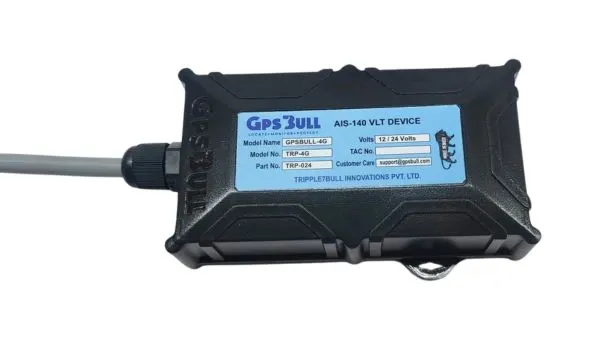
Kerala gets hit by both the south-west and north-east monsoons, and coastal fleets working Alappuzha, Kochi and Kozhikode live in salt-laden humid air year round. Sealed housing is not a marketing line here. The GPSBULL AIS-140-4G ships in an IP68 enclosure and runs on 12/24 V, which covers school buses, tourist coaches, taxis and goods vehicles on the same part number.
The 2G problem
Older trackers fitted on Kerala fleets years ago were 2G. As 2G capacity shrinks, those units go quiet and the vehicle silently stops reporting to the state server, which is exactly the failure that shows up at renewal. See our 2G shutdown and AIS-140 upgrade guide, then look at the 4G AIS-140 device replacement path.
Getting fitted in Kerala with GPSBULL
GPSBULL is a brand of Tripple7Bull Innovations Pvt. Ltd. and manufactures in New Delhi, shipping pan-India to dealers, fitment centres and fleet operators, including across Kerala.
The device
The GPSBULL AIS-140-4G, model TRP-4G (part TRP-024), is AIS-140 certified with ARAI type approval TAC AS9026. It carries GPS + GLONASS + IRNSS (NavIC), 4G LTE with a dual-network embedded SIM, IP68 housing, 12/24 V input, SOS panic button support, tamper and over-speed alerts, remote immobilization, Bluetooth, RS-232, RFID and CAN support, accelerometer, gyroscope, temperature sensing and over-the-air configuration.
It pairs with GBULL CLOUD for live tracking, history, geofences, alerts, reports and driver behaviour monitoring, with open APIs if you already run a fleet management system. We also make speed governors, an OBD-CAN tracker and the GBULL-A10 wired 4G tracker.
Before you order in Kerala
- Confirm your vehicle category and the applicable timeline with your RTO or SRTO.
- Check the model against KMVD's current enlisted list.
- Get it fitted, tagged and confirmed live on Suraksha Mitr, then keep the login details.
- Complete the VLTD entry against the vehicle record. Our Vahan VLTD registration walkthrough covers the sequence.
Pricing is quote-only and depends on quantity, fitment and data plan. Call 1800 270 8677 (toll-free) or write to info@gpsbull.com. Office hours are Mon to Sat, 10 to 7 IST; device support runs 24/7.
Cities and districts we supply in Kerala
Thiruvananthapuram · Kochi · Kozhikode · Thrissur · Kollam · Alappuzha · Kannur · Palakkad · Malappuram · Kottayam — and the rest of Kerala. Devices ship from our New Delhi plant; dealers, fitment centres and fleet operators are supported directly, with 24/7 device support after installation.
Frequently asked questions — Kerala
Is an AIS-140 certificate enough to be compliant in Kerala?
Usually not on its own. Kerala adds two more steps: the device model has to be on the Kerala Motor Vehicles Department's enlisted list of qualified AIS-140 VLTD models, and the fitted unit has to be tagged to your vehicle and reporting to the state's Suraksha Mitr backend. A certificate with no enlistment and no live data on the state server is where most Kerala rejections come from.
What is Suraksha Mitr and do I have to register on it?
Suraksha Mitr is the Kerala MVD's vehicle tracking and monitoring platform, developed with C-DAC and hosted by the department at tracking.keralamvd.gov.in. Kerala VLTDs are expected to report into it so the department, and in the case of school buses the institution and parents, can see the vehicle. Your fitment centre normally completes the tagging, but insist on getting the login and confirming the vehicle is visible before you leave.
Do school buses in Kerala need a VLTD and panic buttons?
Kerala began its VLTD rollout with educational institution buses in 2018 and the department has continued issuing directions to school managements on bus safety. Requirements are notified by category, so confirm the current position for your buses with your RTO. In practice a Kerala school fleet is expected to have a working tracker, reachable emergency buttons and functioning over-speed alerting, checked again at fitness renewal.
What is the deadline for AIS 140 in Kerala?
We do not publish deadline dates, because Kerala has notified categories in phases rather than in one blanket order and the position keeps moving. Confirm the timeline for your exact vehicle class with your RTO or sub-RTO, or check the Kerala MVD website. Treat anything a vendor quotes you as a date to verify, not a fact.
Does my Kerala VLTD need NavIC or IRNSS support?
Kerala's qualified-model lists have been framed around IRNSS (NavIC) capable AIS-140 VLTDs, so it is treated as part of the spec rather than an add-on. It also helps practically on the Munnar, Wayanad and Idukki ghat roads, where canopy and cuttings punish a single-constellation receiver. The GPSBULL AIS-140-4G supports GPS, GLONASS and IRNSS (NavIC).
What does an AIS 140 GPS tracker cost in Kerala?
GPSBULL pricing is quote-only. The cost of a Kerala fitment depends on quantity, vehicle type, whether panic buttons need cabin and saloon wiring, fitment labour and the data plan term, so a single sticker price would be misleading. Call 1800 270 8677 or email info@gpsbull.com with your fleet mix for a written quote.
Fitting AIS-140 devices in Kerala? Talk to the manufacturer.
Speak directly with the manufacturer — device specifications, state-wise compliance guidance, dealer pricing and bulk quotes. Office: Monday–Saturday, 10 AM–7 PM IST. Device support: 24/7.
Official sources
- Kerala MVD: List of Qualified (AIS 140) VLTD Manufacturers
- Suraksha Mitr: Kerala MVD vehicle tracking portal
- Vahan portal (MoRTH)
Rules, deadlines and empanelment lists are set by the state transport department and change over time — confirm the current position for your vehicle category with your RTO before purchase.